Finance is the category where email design carries the most trust risk. It is the
most imitated sector in phishing, its readers are primed for caution, and the
consequences of a misread number are real.
The 4 designs in this collection are plain by design.
Consistency is a security feature
An email that looks unlike your usual email trains readers to accept variation,
which is exactly what an attacker needs. Holding one sender identity, one header,
one type scale and one button treatment across every send is what lets a customer
recognise the imitation.
That argues against seasonal redesigns and promotional flourishes in this category
more strongly than in any other.
Never ask for credentials
No legitimate financial email asks the reader to reply with account details or to
enter a password from a link. Designs in this collection route action through a
"sign in to your account" instruction rather than a deep link with embedded
credentials, and they say so explicitly where relevant.
A line stating what you will never ask for is genuinely useful content.
Figures want structure
Statements, summaries and rate changes should be tables or labelled rows:
right-aligned numbers, the key figure distinct, dates unambiguous, currency stated.
Prose is the wrong container for financial data.
Rate and terms changes
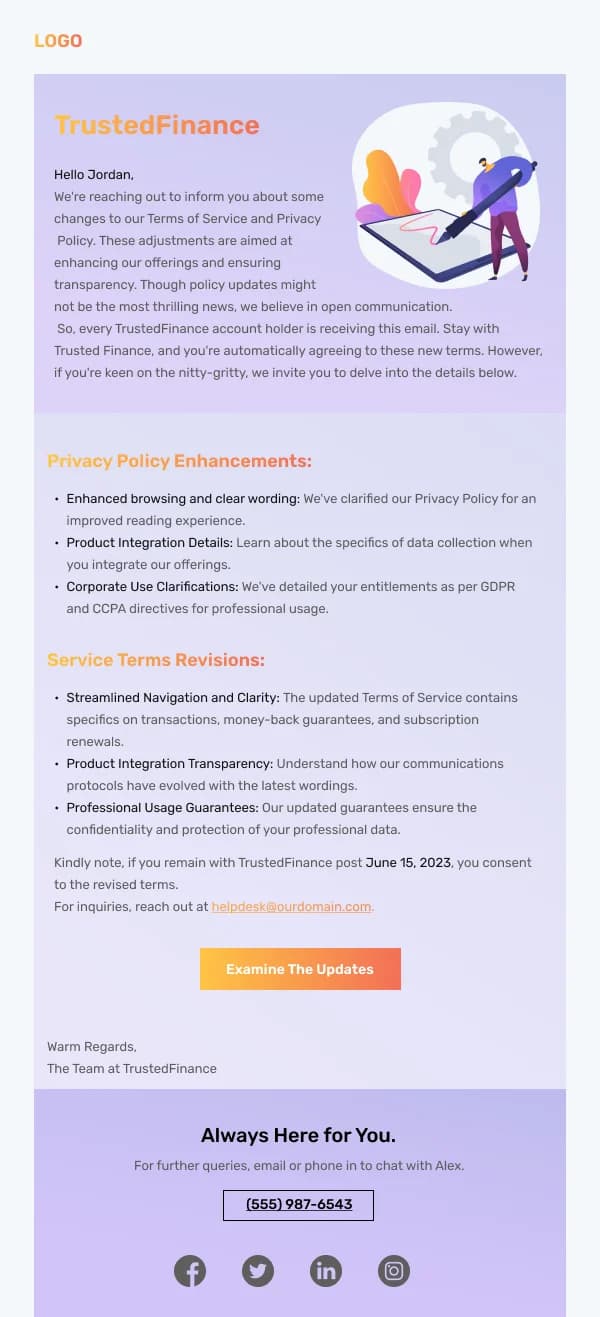
These follow announcement discipline with additional care: the change stated
plainly in the first line including the direction, the effective date in its own
block, what it means for the reader in concrete terms, and the options available.
Describing a reduction in benefit as an improvement is the fastest way to lose the
trust the rest of the design is protecting.
Using these templates
Restrained by design: figures are set in tabular numerals so columns align, and the accent is reserved for the action. Checks: is the sender identity
consistent with your other sends, are figures in structured rows, is the effective
date prominent, and does the email avoid asking for anything a phishing email would
ask for.
Common questions
- What makes a financial email trustworthy?
- Consistency with everything else you send, plain language, no unexplained urgency, and a single unmistakable action. Financial email is the most heavily imitated category in phishing, which means an unusual-looking real email is a genuine liability.
- How should figures be presented?
- As structured data — labelled rows, right-aligned numbers, the key figure visually distinct. Financial information in prose is both harder to read and easier to misinterpret.